

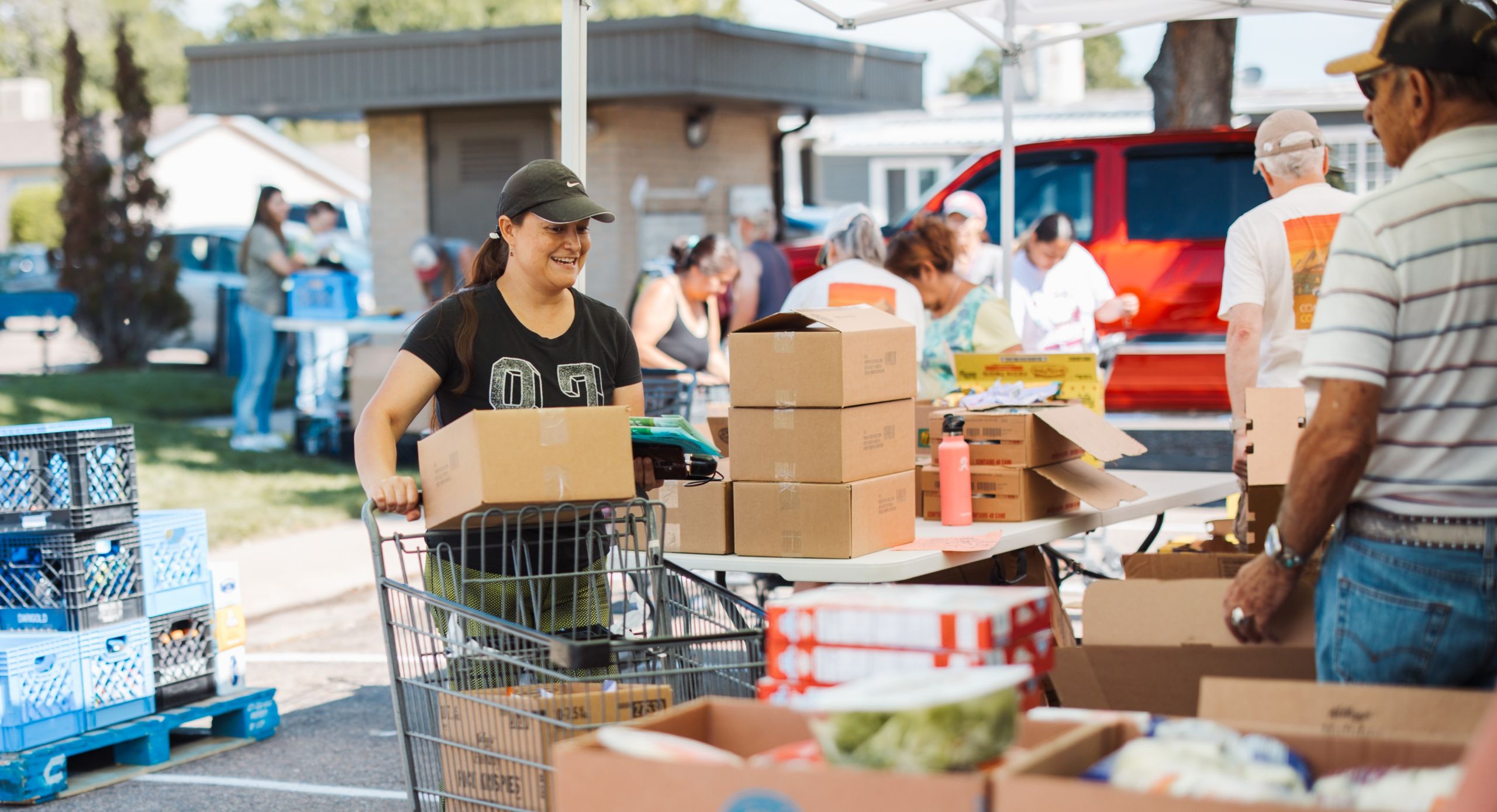
Have you ever wondered how we ensure our food distribution is as effective and efficient as possible? At our Mobile Pantry and Blue Spruce programs, Community Food Share has launched a new intake system. Under our Community Experience Initiative, we are implementing Service Insights on Meal Connect (SIMC), a program developed by Feeding America. We ask our Neighbors questions related to their household, food access, and dietary restrictions, which are entered into SIMC. Each Neighbor receives a check-in-tag, similar to a library card or grocery store loyalty car, equipped with a barcode or QR code. This allows Community Food Share to create a quick and easy check-in experience, which helps our lines move faster and gives us the information we need to better serve our Neighbors.
Here’s what we hope to accomplish:
UNDERSTANDING OUR COMMUNITY’S NEEDS
· When we see that people are traveling a long way to reach one of our pantry locations, we look at the area they are coming from to see if that area lacks adequate resources. We know gas and time are valuable resources and we want people to have access to the resources they need, close to home. So far, we hear from Neighbors that the bar codes are helping to keep the line moving and getting them the services they need in a timely manner.
ENSURING CULTURAL AND DIETARY RESPECT
· Using SIMC, we better understand the demographics of Neighbors using each distribution site. We can better target foods towards families with young children or families with seniors.
· We know how much food is appropriate to hand out by knowing the average household size at each distribution. At some of our distributions, the average household size is one, while at others it is closer to 4.5. Knowing this helps us distribute the food we have more equitably.
· We collect racial and ethnic identities so we can better target culturally appropriate foods. We also ask for dietary restrictions and health conditions that require special diets, so we know if a large number of people can benefit from gluten free, low sodium or allergen free options.
· While most of the food we distribute is donated, we hope that as we improve the data related to these special food needs, we’ll be better able to allocate the funding we do have to purchase food towards areas where it will make the biggest impact.
SECURING OUR NEIGHBORS INFORMATION
· In the past, we had paper intake forms that included a lot of sensitive information being transported between distributions and our main offices. We now ensure our Neighbors’ data remains secure through encrypted digital intake.
ADVOCATING FOR POLICIES THAT SERVE OUR NEIGHBORS
· We ask questions about Neighbors’ disability status and SNAP usage because we know having a person with disabilities in the household increases the chance of a family being food insecure. We know that SNAP usage is one of the most effective tools in our toolbox to combat hunger.
· When we ask our Neighbors about their experiences, we get to know them and can offer them access to additional resources they may not be aware of. We have already helped several families apply for SNAP benefits because of these conversations or referred people to services our Partners offer, such as rent assistance or clothing banks.
· We are collecting important information to ensure our local, state, and national representatives have an accurate picture of food security in our area and can create and align programs to meet the needs of our community. We share non-identified data with Feeding America, to contribute to advocacy on a national level.

WHAT WE DON’T ASK
· We respect the privacy and autonomy of all our Neighbors. It is part of our commitment to dignity and trust. We never ask how much money people make. We know that the amount of money you made last year or the type of car you drive never tells the whole story when it comes to need. When people tell us they need help, we believe them.
· We don’t require anyone to share any information with us to receive food. We provide an option for people to use an anonymous barcode ensuring we do not continue to ask for information they’d prefer not to share. For Neighbors who are comfortable sharing, we ask for addresses, phone numbers, birthdates, and the names and birthdates of people living in the home. We ask questions that determine food security status, disability status, and dietary restrictions. We train our Volunteers to know that this information is never required, that people are free to opt out of any and all questions. We find that most of our Neighbors are happy to share information, knowing we are using it to better serve them and to advocate for better food policy at a local, state, and national level.
FUTURE DIRECTIONS · At Westview Presbyterian Church’s Round Pantry, one of our Partner Agencies, we are actively piloting the SIMC system, helping our Partners gather valuable insights to better serve our community and improving CFS’s ability to deliver to our Partners the products they need to be most effective. We are learning so much about training Volunteers and making the system work for our Partner Network. We hope that in the future the tags people are using at CFS Mobile Pantries today will also be used at several of our partner agencies, decreasing the number of times our Neighbors share the same information to access resources from multiple organizations.
HOW YOU CAN HELP
· Imagine being a part of a movement that ensures no one in our community goes hungry. Join our dedicated team of volunteers! We’re seeking enthusiastic individuals to undergo SIMC training and assist with intake at our mobile distributions or partner agencies. Your contribution could make a significant difference. The system is easy to use, a lot like entering information to buy something online. Our next training cohort begins in early April 2024. Follow this link now to sign up and join us!
QUESTIONS OR COMMENTS
Do you have a question? Would you like to share your experience with our new intake system? We’d love to have your help in hearing more about the diversity of experiences at our programs. Reach out to us at research@communityfoodshare.org